
Tiling a home always looks simpler on paper than it turns out to be on-site. You pick the tile, get a rough quote, and assume the number you see is the number you’ll pay. Then the final bill arrives, and it’s higher than expected because tile installation labor cost per sq ft is only one part of a much longer list of expenses.
If you’re planning a renovation or a fresh build, understanding what actually goes into a tiling budget will save you from awkward surprises later. Here’s a complete breakdown.
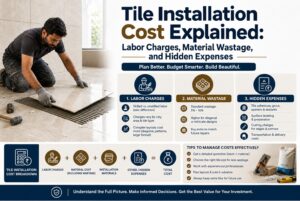
What Decides Tile Installation Labor Cost Per Sq Ft
Labor is usually the first cost people ask about, and for good reason it varies a lot depending on a few factors:
● Tile size and type: Large-format tiles and vitrified tiles need more precision and take longer to lay than standard ceramic tiles, which pushes up the vitrified tile fitting cost.
● Sub-floor condition: An uneven or damaged base needs extra prep work before a single tile goes down.
● Pattern complexity: A straight lay is quicker and cheaper than herringbone, diagonal, or mixed-tile patterns.
● Location within the home: Labor charges for laying floor tiles in open areas differ from tighter spaces like bathrooms, staircases, or balconies, where cutting and fitting take more time.
As a rule of thumb, skilled labor charges scale with the difficulty of the job, not just the area. Two rooms of the same size can cost differently depending on layout and tile choice.
Tile Adhesive Cost vs Cement: Which One Actually Costs More?
This is one of the most common questions homeowners ask, and the honest answer is: it depends on what you’re optimizing for.
Cement-sand mortar is the traditional, lower upfront-cost option. It’s familiar to most masons and widely available. But it comes with trade-offs a thicker application, longer curing time, and a higher risk of hollow tiles if the mix isn’t consistent.
Tile adhesive, on the other hand, costs more per bag but needs a thinner layer, sets faster, and holds vitrified and large-format tiles far more reliably. When you factor in tile adhesive cost vs cement across the full job including reduced wastage, fewer callbacks for loose tiles, and faster project turnaround adhesive often works out to be the more dependable choice, especially for premium tiles.
How Much Tile Wastage Buffer to Buy
No tiling job uses tiles at 100% efficiency. Cutting for corners, edges, and fittings around doors or fixtures always leaves some tiles unusable.
A safe standard is to buy 8–10% extra for straight layouts, and closer to 12–15% if you’re going with diagonal, herringbone, or intricate patterns. Knowing how much tile wastage buffer to buy in advance also protects you from a very specific headache: running short mid-project and discovering the exact tile batch is no longer available, leaving you with a visible shade mismatch.
Tile Grouting Charges: The Line Item People Forget
Grouting often gets bundled into “finishing work” on quotes, which means people rarely question it — until they see it as a separate charge later. Tile grouting charges depend on:
● Grout type (cement-based vs epoxy)
● Joint width and tile size
● Whether stain-resistant or antibacterial grout is used, which is common in premium bathroom projects
Epoxy grouting costs more than standard cement grout but resists staining and moisture far better, making it a smart addition for wet areas.
Cost to Tile a Bathroom vs Other Rooms
Bathrooms are consistently more expensive to tile per square foot than living rooms or bedrooms. The cost to tile a bathroom is higher because of:
● Waterproofing work needed before tiling begins
● Wall tiling in addition to flooring
● More cutting around fittings, drains, and fixtures
● Anti-skid or textured tile requirements for safety
If you’re budgeting room by room, treat the bathroom as its own line item rather than applying a flat per-sq-ft rate across your entire home.
Hidden Expenses That Rarely Make It Into the First Quote
Beyond labor, adhesive, and grouting, a few costs tend to slip through initial estimates:
● Old tile removal and floor leveling, if you’re renovating rather than building fresh
● Skirting tiles along the base of walls
● Transportation and loading charges for tiles and materials
● Edge profiles or trims for a clean, finished look at transitions between rooms
Asking for these explicitly when you request quotes will give you a far more accurate floor tiling cost calculator-style estimate before work begins.
Building a Realistic Tile Installation Budget
A dependable tile installation budget guide accounts for five components together, not in isolation: tile cost, labor, adhesive or cement, wastage buffer, and grouting. Treating any one of these as the “total cost” is where most budget overruns start.
At Maruthi Ceramics, our wall and floor tile range including Nexion, Simpolo, Color Tile, and Dimore is chosen to give homeowners dependable performance without compromising on finish. Speak with our team for a detailed, room-wise estimate before you begin your tiling project, so there are no surprises once the work starts.